Concrete Slab & Foundation Work
Strong, level concrete slabs and foundations built to code for residential and commercial projects.
Understanding Concrete Slabs and Foundations
Whether you are building a new garage, shed, home addition, or other structure, the foundation is the most critical component. A properly constructed concrete slab or foundation provides stable support that lasts for generations. This is not an area where you want to cut corners or take chances. The entire structure depends on a solid base that resists settling, cracking, and moisture problems.
In Westford and throughout Massachusetts, our soil conditions and climate present specific challenges. Frost can penetrate deep into the ground during winter, causing heaving and movement. Clay soils expand and contract with moisture changes. These factors require careful planning and proper construction techniques. We design and build foundations that account for local conditions, and like any skilled concrete pad contractor, we make sure the work meets or exceeds building codes and stands up to environmental stresses.
Working with an experienced concrete contractor means your project starts on the right foundation. We handle all aspects from site evaluation and permit applications to excavation, forming, pouring, and finishing. Our team has the equipment and expertise to complete foundation work efficiently while maintaining the highest quality standards.
Types of Concrete Slabs and Foundations
Slab-on-Grade Foundations
A slab-on-grade is a single layer of concrete poured directly on the ground. This is the most economical foundation type and works well for garages, sheds, additions, and single-story buildings. The slab serves as both the foundation and the floor. We thicken the edges of the slab to provide extra support where walls will sit. This thickened edge acts like a footer, distributing the weight of the structure across a wider area.
For slab-on-grade construction, proper site preparation is essential. We excavate to below the frost line at the perimeter and install a gravel base for drainage. Vapor barriers prevent moisture from wicking up through the concrete. Reinforcement with rebar or wire mesh controls cracking. The slab is typically 4 to 6 inches thick in the center and 12 inches or more at the thickened edges.
Frost Wall Foundations
In our climate, many structures require frost walls. These are concrete or concrete block walls that extend below the frost line to prevent frost heaving. The walls create a perimeter foundation, and a concrete slab is poured inside. This type of foundation is common for heated buildings, homes, and larger structures. Frost walls distribute building loads to stable soil below the frost depth.
We pour concrete footings first, which are wide bases that support the frost walls. The walls are built on these footings, creating a stable foundation system. Once the walls cure, we backfill around them and pour the interior slab. This approach provides excellent long-term stability and creates a solid base for your structure.
Specialty Slabs and Applications
Beyond standard foundations, we handle various specialized concrete slab projects:
- Equipment pads for HVAC units, generators, and machinery
- Shed and barn foundations sized for your specific building
- Workshop floors with extra thickness for heavy equipment
- Garage floor slabs ready for vehicles and storage
- Basement floors poured after foundation walls are in place
- Commercial slabs for retail spaces, warehouses, and offices
- Utility pads for transformers and mechanical equipment
Each application has specific requirements for thickness, reinforcement, and finish. We design the slab to match the intended use, ensuring adequate strength and durability. Whether you need a simple equipment pad or a complex foundation system, we have the experience to build it correctly.
Our Foundation Construction Process
Site Evaluation and Preparation
Every foundation project begins with careful site evaluation. We assess soil conditions, drainage patterns, and access for equipment. Poor soil may need to be removed and replaced with compacted fill. Areas with high water tables might require additional drainage measures. We also locate underground utilities to avoid damage during excavation. This planning phase prevents problems that could compromise your foundation.
Once planning is complete, we begin excavation. For slab-on-grade, this means digging out the area to the proper depth and creating trenches for thickened edges. For frost wall foundations, we dig down to below the frost line. In Massachusetts, this typically means going 4 feet deep or more. We use excavators and other heavy equipment to move earth efficiently. The excavated area is graded level and compacted to create a stable base.
Base Installation and Forming
After excavation, we install the base materials. This typically includes several inches of crushed stone or gravel. The stone provides drainage and prevents water from accumulating under the slab. We compact the stone thoroughly using mechanical equipment. A well-compacted base prevents settling that could cause cracks later. For slabs inside heated buildings, we also install rigid foam insulation under the concrete for energy efficiency.
Next, we build forms that define the shape and dimensions of the slab. Forms are typically made from lumber and must be precisely level and square. We use laser levels and string lines to ensure accuracy. Any embedded items like anchor bolts or electrical conduits are positioned at this stage. We install vapor barriers to prevent moisture transmission. Reinforcement is placed on chairs that hold it at the proper height within the slab.
Concrete Placement and Finishing
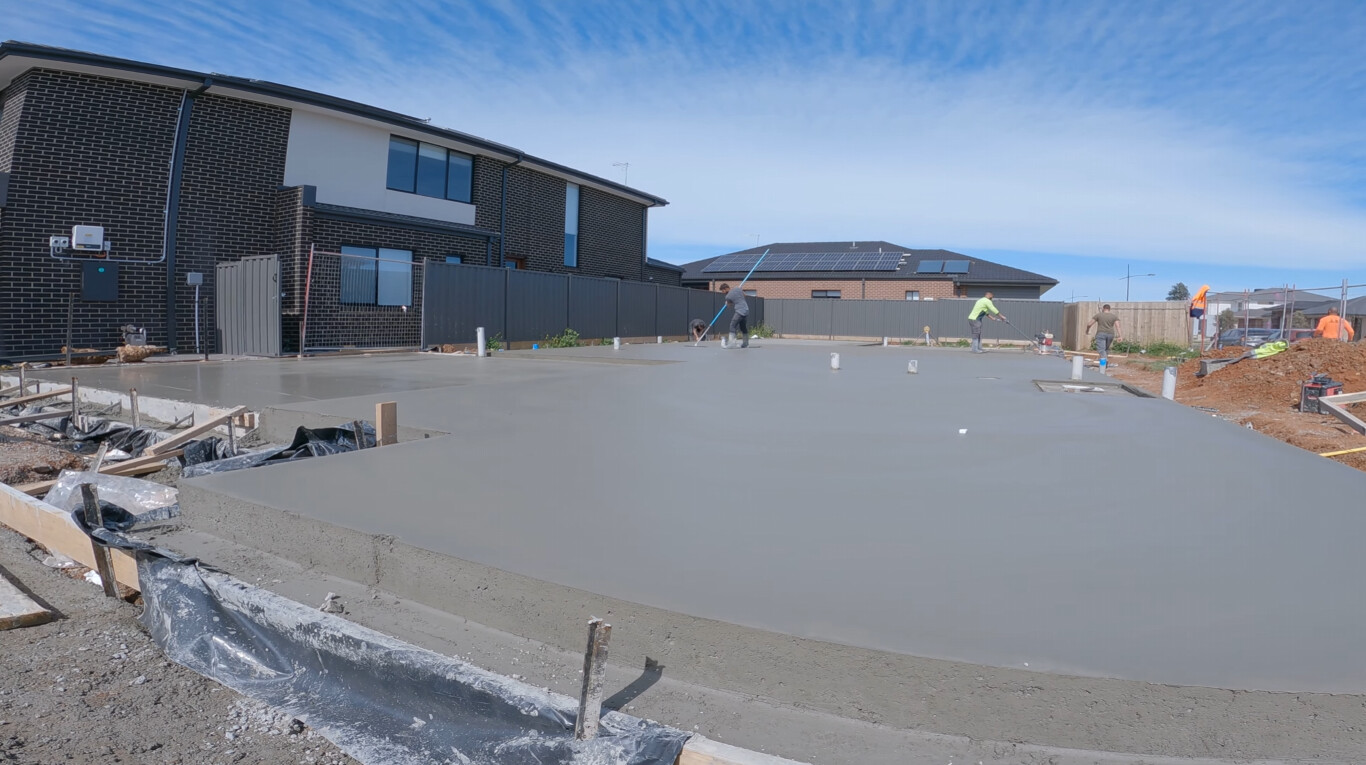
On pour day, ready-mix concrete is delivered by truck. The mix design is specified for the application, usually with a minimum compressive strength of 3,000 to 4,000 psi. We pour the concrete and spread it evenly throughout the forms. For large slabs, this requires coordination between multiple crew members. The concrete must be placed and finished before it begins to set.
We screed the surface to the proper level using straightedges. This removes excess concrete and creates a flat surface. After screeding, we use bull floats to further smooth and level the concrete. The finish depends on the use. Driveways and outdoor slabs get a broom finish for traction. Interior slabs receive a smooth trowel finish. For floors that will be covered with other materials, a rough finish provides better adhesion.
Curing and Quality Assurance
After finishing, proper curing ensures maximum strength. We apply curing compounds and keep the concrete moist for at least seven days. During this time, the concrete gains strength through hydration. We protect fresh concrete from extreme temperatures, rapid drying, and physical damage. Control joints are cut or formed to manage cracking. These joints allow the concrete to crack along predetermined lines rather than randomly. Once fully cured, your foundation is ready for the next phase of construction.